Showing posts with label Rubus fruticosus. Show all posts

Saturday, 13 September 2014

Herbst

It's been a while, to say the least.  My first year as an undergrad was mayhem mayhem, so I've cashed out for an HNC.  I had the grades, no problems there.  It was pretty much straight Distinctions in everything, but the politics got to me.  Suffice it to say I've been busy.

My first niece, Ellie, was born in December.  She's adorable.  I shan't blog photos though because internet.

Got away over the Summer.  When you're part of the many worlds that I inhabit you tend not to have a circle of friends so much as a diaspora, so I arranged a list of couches to crash on, got myself a Golden Ticket - *sings the line* - and went off to see, well, the UK I guess.  England and Scotland at any rate.


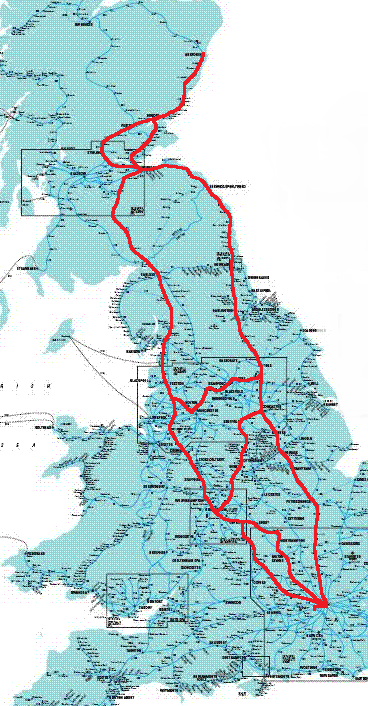
I ended up staying in Aberdeen, Northampton, Dundee, Inverkeithing, Manchester, and Leamington, with stops in Stonehaven, London, Edinburgh, Newcastle, York and Coventry, before ending the Summer in Brighton with Julia from Stages of Succession where I picked up an award!  


In all, I probably racked up 3,000 miles in three weeks.  It was awesome!  This map by @scattermoon doesn't show the Brighton leg but other than that the lines taken are accurate, it should give you some idea.


Muchly recommended!  If you get the chance to put in a fortnight city-hopping then do so.  I saw more museums and galleries in that short space of time than I do in the average year.  I went on the RRS Discovery, stood inside a mock-up of the Large Hadron Collider, finally saw Body Worlds, and got to stand on the footplate of a very handsome steam engine.  Ain't stopped grinning since :)

So the garden then.  The garden has changed considerably.  The buddleia got cut down, so I put in fruit trees, thornless brambles and rosemary.  I've also painted the railings British racing green so's they don't make the place look like a doctors' surgery any more.  Alas, with the shade from the departed buddleia having gone away I'm having weeds come up out of the ramp faster than I can pull them out, but once the trees get a little bigger that'll sort itself out.  


On the left along the fence line are three cherries: morello, dessert, and another morello.  Visible on the right, between ramp sections, is a family-grafted apple and behind that, near to the taller fence is a family-grafted pear.  

As you can see I'm training thornless bramble to wind around the railings.  This year's growth will turn woody next year, providing a broad and steady platform for next year's growth.  In time the railings will all be covered in blackberries, I may even put in an arch with bamboo and have blackberries cascading above the ramp.  Yum!  Ellie's been picking blackberries all Summer, she loves them.  

My new bay project - Stan - is coming along nicely.  Here he is next to the entry out front.  


That's all thyme in there.  The two in front are orange thyme, then three lemon thyme in the middle, Stan in back.  Oh you should smell that planter after a storm!  

Out back, meanwhile, I've had a little change of heart.  My veg beds will never grow anything like enough veg to feed my lot, but they can grow enough herbs.  They're now my herb beds.  The little ones that were my herb beds are now my odd-job beds.  The fruit bed is mostly planted, save for raspberries which aren't even stocked until October.  


From the left we have rose, thorned bramble, three kinds of blueberry, a fig, and loganberry on the right.  The roses and brambles are to discourage a cat from sitting on the Strawbrary because it pisses George off, who then runs around the garden frantically, and my flower beds get trashed.  No cat, no crazy dog, no destruction.  

This being Autumn now I'm drying rosemary for storage, where it'll keep us in home-grown herbs until the Spring.  

And meanwhile we've got enough fresh in the kitchen to last us a while.  

Rosemary - Sage - Thyme - Bay

Looks kinda Skyrimesque.  Ah well, until next time :) 

Wednesday, 27 February 2013

Wednesday, 5 December 2012

Rosie and Jim Go Outside

Finishing revisiting childhood in 3... 2... 1...

I'm back.

So we've got some new additions to the garden this morning.  Rosie and Jim are from Rubus 3 and they've taken up residence on the roof of the Strawbrary.


Bill is vaguely interested in the mysterious floating plant pot.  George is convinced that it's here to kill us all!  Meanwhile, the experiment's own page now comes up top on Google when you search for The Rubus Experiments, which is pretty awesome.

Sunday, 25 November 2012

Wa-Hey!

Looks like I haven't just killed thirteen bramble cuttings!  This is excellent!  It means that the experiments are definitely going ahead (I've been biting my nails over this one) and that at the end of it I'm likely to have a viable plant with which to carry on the lineage of brambles that have lived up to now in the front garden.  Think in terms of Noah's Ark if that helps.

Pics when the camera turns up.

Monday, 19 November 2012

The Rubus Experiments, pt. 2

I'll be setting this one up tomorrow.  Broadly the same set-up as for Rubus 1, but with different variables:

Windowsill 'Tilly' (my bedroom)

  • Hot
  • Average humidity
  • Maximum direct Sun
Windowsill 'Tom' (dining room)
  • Hot
  • Very dry
  • High Sun
Windowsill 'Tiny' (living room)
  • Warm
  • Average humidity
  • Minimum direct Sun
Windowsill 4 (Rubus 1 group)
  • Coolest, though warm still
  • Most humid
  • Second-highest direct Sun
From Rubus 1, only Milo and Doodle will be involved in Rubus 2.

Further updates will now be found at rubusexperiments.blogspot.co.uk

The Rubus Experiments, pt 1

Note to secondary and FE biology teachers: feel free to use this as an example of a simple and practical botanical experiment.  The link presently comes up second on the first page of Google when searching for "The Rubus Experiments".  The Rubus tab across the top of the page will link to the site where I'm posting the experiments progress.  

  The ramp out front needs replacing as it is presently bridging the damp course.  Everyone finally admits it, so that'll likely happen a few months from now.  The ramp covers more than half the surface area of the front garden, so it'll mean something of a slash-and-burn of plantlife out there.  That Buddleia will go (TFFT!) but so will my brambles.  Those brambles have been there for over ten years and they're a brilliantly heavy cropper.  Every year in late Summer/early Autumn we have more blackberries than we know what to do with.  I didn't plant the bramble myself and nobody knows how many generations of Rubus have grown here.

  More important than sentiment is genetics.  Genes are like stories: they shift in the retelling.  The verses which suit the culture tend to be retained, to grow and to flourish, whilst those which don't will fade into obscurity.  That plant has a genetic heritage which enables it to hold its' own in that place, that soil, those conditions, in spite of competition from other plants.  That plant belongs to that garden, and a similar bramble bought from the garden centre might not suit the space in the same way.

  What to do, then?  Well, I intend to keep the bramble one way or another, but if the bulk of it must be chopped down then I might as well try some stuff out.  I'm not saying this'll work, so you shouldn't take this as a guide to action.  Still, here's what I'm getting up to:

The tools I'll need.  
I've filled the pots with soil from my garden, the same soil the parent plant is growing in.  Most would say to use potting compost, and I'd tend to agree.  My soil is crumbly, silty loam which successive gardeners since the 1930s have dug endless peaty compost into.  If I wanted a better medium for growing I'd have to invent it.

I took the soil from the beds.  Specifically from a point furthest from where my V. faba are growing.  No sense in depriving the beans at this time of year.  Once filled, I took cuttings from shooting tips of the Rubus. They're easily spotted by the claw-like, mitroid tips.  These are where new growth is happening most vigorously, so they should be most likely to take root.  The greenest shoots are best.  Prior to cutting the blades of the scissors were suspended in a pan of water as it boiled.
The growing end of a vine.  
The shoot cutting, size 7 hand for scale.  

I took only healthy shoots, avoiding any that had a problem with greenfly.  Heh, "problem", kinda makes it sound like "if you're not talking to your plants about greenfly..."  Aaanyways; once a shoot cutting was taken, it had to be rinsed under the tap.  A good soaking helps prepare the cuttings.  A hole was made in the centre of my potted soil using a skewer and the cut end put into the soil.  I then used my thumbs to press the soil down gently, just enough to close the hole without compressing the soil.  


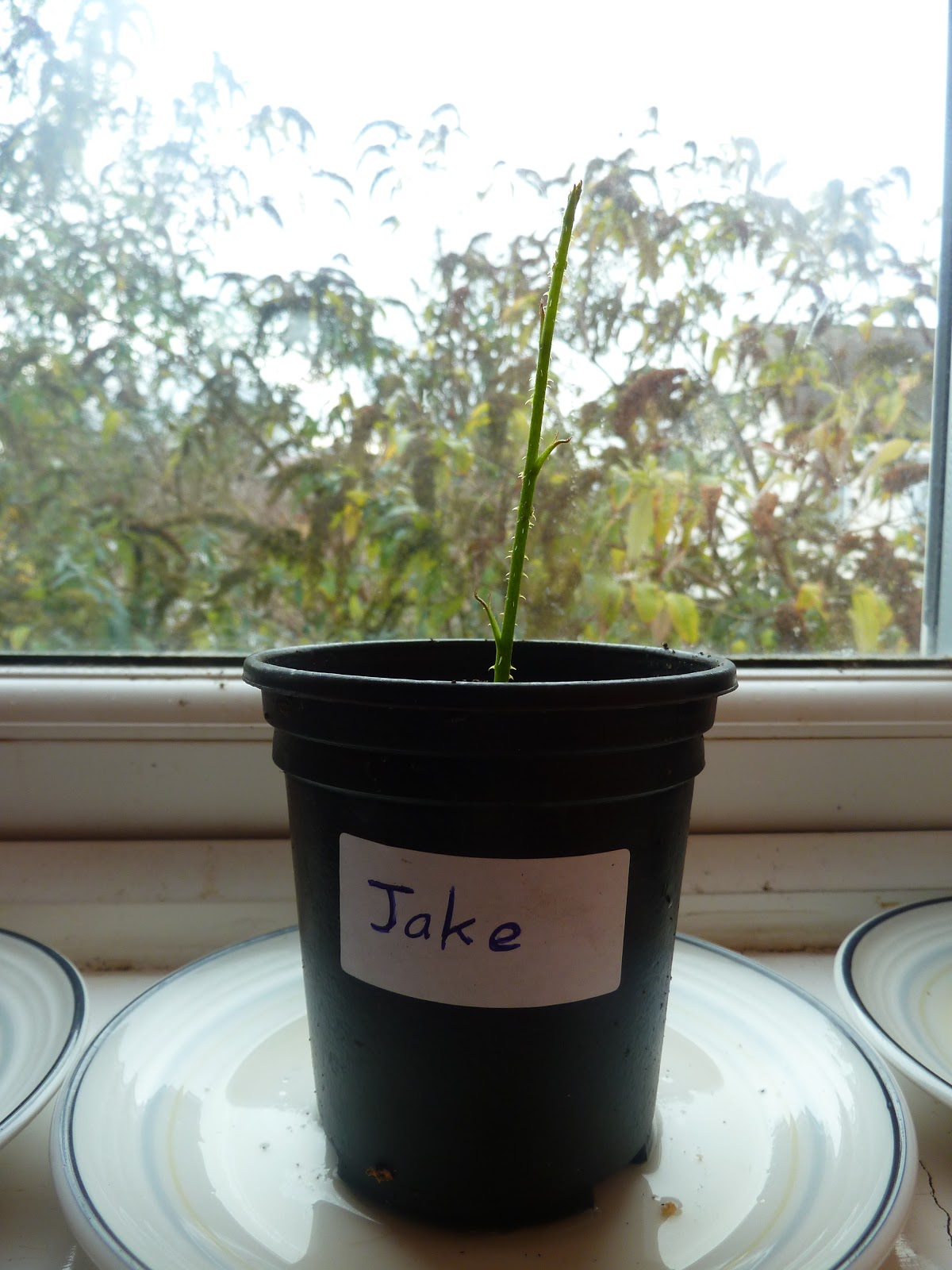
I've made five of these - each of roughly the same length - and put them in the Nursery.  Mike has been relocated to my bedroom windowsill for the duration.  Mike seems to be recovering well from his infection.  Once there they each got a solution of 4:2:6 up to the yellow line on the saucer.  Now for the experiments.  I say experiment, but these are more akin to case studies than true lab experiments, albeit with certain controls in place.  

  1. I've taken four cuttings of thin, green shoots.  One of a thicker, purpling shoot.  Which will fare better?
  2. Two of my shoots curve.  I've pointed the tips of these away from the Sun, where normally plants bend toward the Sun.  Will the phototropic action of auxins cause the whole shoot to straighten up as it brings itself sunward or will the tip kink towards the Sun instead?  

Basic exercises in botanical study, but interesting for all that.  I'll observe the cuttings over the coming months and report on their progress.  Here's the five as they stand today: